ai
27 Topics
So lucky to be taking AI
Im so lucky to have started five years ago ..diagnosed with Mets and on my second AI Yes it can be a choice we are given For most of us the side effects are doable if not try another But for me they have slowed the mets progression The recommendation for bc hormone postive therapy is try and stay on on it for 10 years .for some it will be hard to do the long haul All the best with your decisions For me I do not have a choice Bright in hope 135ViewsSign in to react to this post
 3Comments
Policy & Advocacy Update - Vicki Durston - Feb26
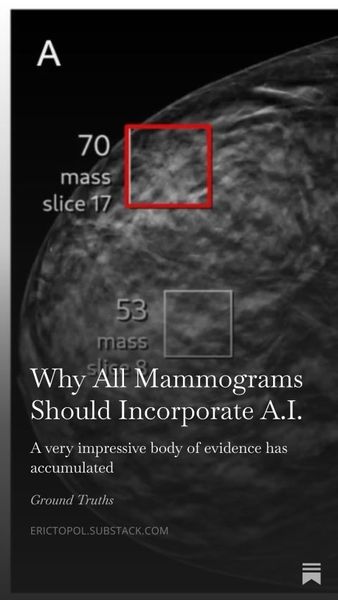
As we continue to move through 2026, there’s a real sense of progress building across breast cancer outcomes - both here at home and internationally. I want to share two important moments that highlight how evidence, leadership, and advocacy are shaping a better future for those affected by breast cancer. ✨ Why AI in mammography can’t wait Eric Topol’s recent article, “Why All Mammograms Should Incorporate AI,” brings together powerful evidence showing that AI in breast screening is no longer a future idea - it’s part of modern, effective care today. One of the strongest examples is the large MASAI trial from Sweden, involving more than 105,000 women. When radiologists used AI as support, the outcomes were remarkable: 👉 29% more cancers detected 👉 24% more invasive cancers found 👉 No increase in false positives or recalls 👉 44% reduction in radiologist workload Two-year follow-up findings were equally compelling: fewer interval cancers, fewer invasive cancers, and fewer aggressive types such as triple negative and HER2-positive cancers. What international evidence now shows International evidence is telling a very consistent story. Large trials and real-world evaluations show that AI-supported mammography can safely increase cancer detection while reducing radiologist workload, without increasing false positives or unnecessary recalls. This matters in a system already under pressure. AI is also changing how we think about risk. New image-based risk models can analyse a mammogram that appears “normal” to the human eye and still identify women at higher risk of developing breast cancer in the next few years. This opens the door to more personalised, risk-stratified screening, rather than the one-size-fits-all model we rely on today. Here in Australia, BreastScreen is a highly respected program, but it was designed more than 30 years ago. While Victoria and NSW are now piloting AI within their services, we still lack a coordinated national approach for integrating AI into breast screening that reflects today’s evidence. What BCNA is calling for We are now at a decision point. The question Eric Topol poses - “If not now, then when?”- is the same challenge facing Australia. For BCNA, this is not about chasing technology for its own sake. We are calling for AI to be treated as a core part of the evolution of breast screening, not an optional add-on. That means: Embedding AI research, evaluation and implementation within BreastScreen Ongoing, in-program national investment in screening research and quality improvement Ensuring that the benefits of new technology are delivered equitably, so no woman is left behind because of where she lives or her background If we get this right, AI won’t replace the program Australians trust - it will strengthen it, helping detect cancers earlier, supporting an overstretched workforce, and moving us closer to truly personalised, risk-stratified screening.79ViewsSign in to react to this post0Comments
Aromasin and weight gain, now I know Im not going mad...
Hey all, I had to share this as Ive thought I was going mad all these years, but now I know I'm not. I finished my treatment for my 2nd diagnosis in 2015 and was placed onto Arimidex, I was then changed to Aromasin. Post chemo I put on 6kg, this has blown out into 8kg now, to many they would say it wasn't much. However, in 3yrs I have tried EVERYTHING! exercise and diet, I would lose a little but it would reset itself back or more and now I know why. I am stuck on this for a further 2 yrs after discussions with my Oncologist, but Im upset that this is not discussed in depth with patients. I say this only from the point of full knowledge and understanding, not as to whether I would take it or not. This is purely for knowledge and knowing WHY I cannot get this weight off and so I can stop blaming myself and beating myself up. I will still continue to exercise and watch my diet, eventhough I know whilst on this medication not much will change, knowledge is just power isn't it? in a way Im relieved. Its hard to not get caught up in this post recovery of finding your new normal, but it doesnt help when we aren't told everything. There is light at the end of it I hope LOL Exemestane (AROMASIN) is a steroidal Aromatase Inhibitor (AI) Your extra weight may hang around and increase after chemotherapy if you also take hormonal therapy (tamoxifen or an aromatase inhibitor). If your body shifts into menopause because of chemotherapy, there's a tendency to gain weight. ... It's important to know that the hormone estrogen suppresses LPL activity on fat cells. The enzyme lipoprotein lipase (LPL)plays a major role in the metabolism and transport of lipids, and consequently is a participant in the development of obesity•One of its roles is to remove triglycerides from the blood for storage in both adipose tissue and muscle cells.••Enzyme activity may also explain why some people who lose weight regain it so easily. After weight loss and weight stabilization, adipose tissue LPL is increased and its response to meals is heightened.•People easily regain weight after having lost it because they are battling against enzymes that want to store fat. Fat storage is efficient, and fat oxidation is not•The activities of these and other proteins provide an explanation for the observation that some biological mechanism seems to set a person’s body weight or composition at a fixed point; the body will make adjustments to restore that set point if the person tries to change it. Hope this helps others understand why they can't shift that extra weight post treatment and know you too ARE NOT GOING MAD!!! Hugs everyone, am wishing 2 more years away as currently am 8yrs on combined medications and had enough! xx M7.1KViewsSign in to react to this post33CommentsAI Breast Cancer Risk Tool Back in the Spotlight 🧠
A topic that's come up in our Online Network in recent times is making headlines again - the use of artificial intelligence (AI) to better predict breast cancer risk. ABC News has reported on the new Australian research showing that an AI tool called 'BRAIx' can identify women at high likelihood of developing breast cancer even when their mammograms show no signs of cancer. Read more via the link Artificial intelligence detects high breast cancer risk in women given all-clear According to the study, 1 in 10 women who fell in the top 2% of risk scores did go on to develop breast cancer, despite having been given the “all clear” at screening. The team behind the project says the tool could be ready for wider use within about five years, potentially opening the door to more personalised screening rather than the current one‑size‑fits‑all approach.109ViewsSign in to react to this post2Comments
Giredestrant Reduces Recurrence Risk More Than Tamoxifen, Aromatase Inhibitors - lidERA Trial
Is/was anyone on the 'lidERA' Trial? Apparently there is evidence that Giredestrant may Reduce Recurrence Risk up to 30% More Than Tamoxifen, Aromatase Inhibitors. https://www.breastcancer.org/research-news/giredestrant-reduces-recurrence-risk-better-than-tamoxfen-and-aromatase-inhibitors Giredestrant Reduces Recurrence Risk More Than Tamoxifen, Aromatase Inhibitors Results from the lidERA trial suggest that giredestrant could be a new standard of care for early-stage hormone receptor-positive breast cancer. Written by Jamie DePolo | Reviewed by Kevin Fox, MD Published on December 21, 2025 In this article Taking giredestrant after surgery to remove early-stage hormone receptor-positive HER2-negative breast cancer seems to lower the risk of the cancer coming back (called recurrence) more than taking tamoxifen or an aromatase inhibitor. Giredestrant is a new oral selective estrogen receptor downregulator (SERD), a type of hormonal therapy. The research was presented at the 2025 San Antonio Breast Cancer Symposium. Key takeaways People who took giredestrant were 30% less like to have any type of recurrence — cancer coming back in the breast area or in any part of the body — than people who took tamoxifen or one of the aromatase inhibitors: Arimidex (chemical name: anastrozole), Aromasin (chemical name: exemestane), or Femara (chemical name: letrozole). People who took giredestrant were 31% less likely to have distant or metastatic recurrence — cancer coming back in a part of the body away from the breast — than people who took tamoxifen or an aromatase inhibitor. The side effects of giredestrant were similar to those of tamoxifen and the aromatase inhibitors – hot flashes and joint and muscle pain – but they appeared to be less severe. About 5% of people taking giredestrant stopped treatment because of side effects compared to about 8% of people taking an aromatase inhibitor or tamoxifen. What the results mean for you Longer follow-up of the study is needed, but if the results are confirmed, the findings could mean the first major change in treatment after surgery for early-stage hormone receptor-positive breast cancer in more than 25 years. While giredestrant isn’t yet approved by the U.S. Food and Drug Administration (FDA), Genentech, the company that makes it, is expected to apply for approval very soon. Why do the study? After surgery, many people diagnosed with early-stage hormone receptor-positive HER2-negative breast cancer take hormonal therapy, usually tamoxifen or an aromatase inhibitor, for five to 10 years to lower the risk of recurrence. Although survival rates are high with this treatment, up to 33% of people have the cancer come back. Research also shows that many people struggle with the side effects of tamoxifen and the aromatase inhibitors; studies suggest that up to 50% of people either don’t start their prescribed medicine or stop taking it early. “In early [estrogen receptor]-positive breast cancer, challenges with disease recurrence and treatment adherence mean there is an urgent need for more effective, tolerable endocrine therapies,” Aditya Bardia, MD, MPH, professor of medicine at the David Geffen School of Medicine at UCLA, said during a media briefing on the results. Bardia is also director of translational research integration at the UCLA Health Jonsson Comprehensive Cancer Center. Bardia and his colleagues studied whether giredestrant could be a better option than currently used hormonal therapies. About the study The lidERA study included 4,170 people diagnosed with stage I to stage III hormone receptor-positive HER2-negative node-positive breast cancer. Half the people were older than 54 and half were younger. About 60% were post-menopausal. After surgery, the people were randomly assigned to one of two treatments for five years: 2,084 people took giredestrant 2,086 people took tamoxifen or one of the aromatase inhibitors, whichever their doctor recommended; if people had unacceptable side effects, they could switch to a different aromatase inhibitor Detailed results Three years after completing the five years of treatment, 92.4% of the people who took giredestrant were alive with no recurrence compared to 89.6% of people who took tamoxifen or an aromatase inhibitor. This difference was statistically significant, which means that it was likely due to the difference in treatments and not just because of chance. This benefit was consistent regardless of menopausal status, cancer stage, and whether or not a person had received chemotherapy before surgery. Information on overall survival — how long people live whether or not the cancer comes back — wasn’t ready to be analyzed. But Bardia said there was a trend for better survival with giredestrant. The most common treatment-related side effects in both treatment groups were mild and included joint pain, hot flashes, and headache. Less than 2% of the people in either treatment group had serious side effects, such as high blood pressure and joint pain. Bradycardia, or a slow heart rate, is a known side effect of oral SERDs. About 11% of people who took giredestrant had bradycardia compared to about 3% of people who took tamoxifen or an aromatase inhibitor. But most of these cases were grade 1, caused no symptoms, and didn’t require people to pause or stop treatment. “The frequency of side effects were similar, including the frequency of [joint pain], with giredestrant and the standard of care endocrine therapy,” Bardia said during an episode of The Breastcancer.org Podcast, “but treatment discontinuation because of [joint pain] was lower with giredestrant compared to the standard of care endocrine therapy.” References Bardia A., et al. Giredestrant vs standard-of-care endocrine therapy as adjuvant treatment for patients with estrogen receptor-positive, HER2-negative early breast cancer: Results from the global Phase III lidERA Breast Cancer trial. SABCS 2025, Abstract GS1-10.178ViewsSign in to react to this post1CommentManagement of Aromatase Inhibitor–Induced Musculoskeletal Symptoms
There are plenty of Oncologists who STILL dismiss side effects from AIs (Aromatase Inhibitors) as either being a figment of our imagination, or they say/think the side effects aren't as severe as we advise them ..... just print this off & give it to them. They may learn something! Aromatase inhibitor–induced musculoskeletal symptoms (AIMSS) were first recognised as a distinct entity in 2001, 5 years after the approval of the first aromatase inhibitor, anastrozole. (I reckon Carpal Tunnel is about the only symptom/side effect I HAVEN'T had over the last 4.5 years from the list below ....) AIMSS can have a protean presentation, most commonly including joint pain and stiffness (including morning stiffness), but also carpal tunnel syndrome (CTS), tenosynovitis, myalgia, and muscle weakness, such as reduced grip strength. Symptoms can be continuous or intermittent and can involve more central joints (spine, hips, shoulders), peripheral joints (elbows, wrists, knees, feet), or both. You can Read the full report here: https://ascopubs.org/doi/full/10.1200/OP.20.00113218ViewsSign in to react to this post6CommentsAn interesting paper on AIs - Precautions for Patients Taking Aromatase Inhibitors
Published online 12 months ago .... well worth a read. https://www.ncbi.nlm.nih.gov/pmc/articles/PMC7848814/?fbclid=IwAR04ZJ9xKopWQUYtDosUz5Xl3Q0ynCsYMKOkkOI5tWgyj9LM7Bldx4i0Eg0 Below, a list of medications to be avoided on AIs (Letrozole & Exemestane mainly).... (also in the doc above, but here as a separate document.)142ViewsSign in to react to this post1CommentOnline Event: Improving Breast Cancer Risk Prediction with AI 🤖
Artificial intelligence is playing an increasingly important role in breast cancer research, and this upcoming online Breast Cancer Grand Round explores how AI could help personalise breast cancer screening in the future. 💗 Presented by A/Prof Davis McCarthy, this session will discuss the BRAIx risk score, an AI-based tool developed using BreastScreen Victoria mammograms to help predict a woman's current and future breast cancer risk. Researchers found the tool was a strong predictor of intermediate-term breast cancer risk and may help support more personalised, risk-based screening approaches. 📅 Wednesday 7 October 2026 🕐 1:00pm to 2:00pm AEDT 💻 Online 🎯 Mainly aimed at clinicians and researchers, but suitable for anyone interested in the future of breast cancer detection and screening. As technology continues to evolve, research like this is helping explore new ways to identify risk and improve breast cancer outcomes through more tailored screening pathways. 💕 🔗 Register here: https://www.eventbrite.com.au/e/bcgr-featuring-aprof-davis-mccarthy-tickets-2000232079996 Have you heard much about the use of AI in breast cancer screening and diagnosis? We'd love to hear your thoughts in the comments. 💬💗54ViewsSign in to react to this post1Comment💡 Curious about how AI is helping predict breast cancer risk?
If you’ve ever wondered what all this “AI” talk is about (and whether it’s more than just robots and buzzwords!), there’s an upcoming session you might enjoy. The VCCC Alliance is hosting an online event all about how AI is being used to improve breast cancer risk prediction. It’s designed for everyday people, no tech background needed, no fancy jargon required. Just bring your natural curiosity and perhaps a comfy chair and a cuppa. ☕ Tune in: 🗓 30 Mar 2026, 1.00–2.00pm AEDT 📍Online, register here104ViewsSign in to react to this post3CommentsFOXA1 gene shows resistance to AIs .... genomic mutation
In September 3, 2020 a study published by Memorial Sloan Kettering Cancer Center indicates how genomic mutations in FOXA1 can cause cancer drug resistance to AIs. FOXA1 might be one to be added for Genomic testing here in Aus - no point being on AIs if the gene is resistant to it! https://www.mskcc.org/news/mutations-same-gene-create-different-paths-breast-cancer-drug-resistance?fbclid=IwAR0jIFetNV-6ulvLhDYnQNViwN3hoYsSdmgFQxt1MzTxaknVSHGlD_n7O_c Technically your tumour samples should be kept for some years - so they SHOULD be able to be sent for testing/Oncotyping ..... (my husband's first tumours from 2010 had genome sequencing done earlier this year, as well as those from the biopsies taken in Jan - to see if they were the same cancer & whether more modern treatments were available ....)40ViewsSign in to react to this post0Comments