🔔 Update on access to Zoladex treatment
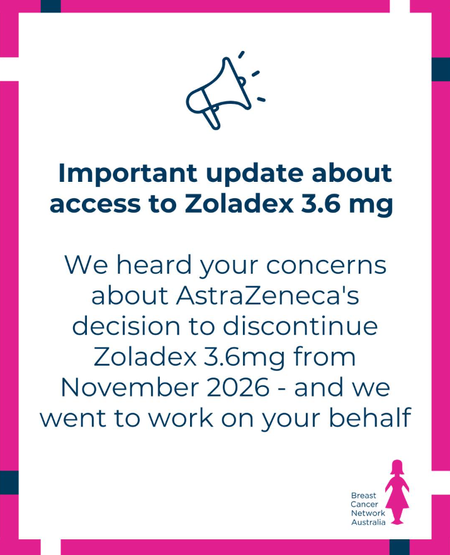
We heard your concerns about AstraZeneca's decision to discontinue Zoladex 3.6mg from 1 November 2026 - and we went to work on your behalf. After coordinating advocacy with clinicians, consumers and key stakeholders, we're pleased to share that options will be available for those affected, including a free access program for eligible patients and work underway on alternative treatment pathways. Supply continues in the meantime and we'll keep you informed every step of the way. Full details available through the link in our bio. If you need support, our Helpline is here for you on 👉 Reach out to the BCNA Helpline 1800 500 258 for information and support Read more here: 🔗 https://www.bcna.org.au/latest-news/bcna-news/update-on-access-to-zoladex-treatment230Views5likes7Comments🏈 Join Us for the 2026 Pink Lady Match! This Weekend - Aug 8
The iconic Pink Lady Match is back for 2026, and we'd love to see our BCNA community there! For more than 22 years, the Melbourne Football Club has proudly partnered with BCNA, helping raise awareness and support for the thousands of people diagnosed with breast cancer each year. Join us this year at the MCG as the Melbourne Demons take on the Fremantle Dockers in support of Australians affected by breast cancer. Whether you're cheering from the stands in the Pink Lady Bay or supporting from home, every show of pink helps make a difference. Tickets for Pink Lady Bay are limited, so be sure to register early. The match will also be broadcast on Fox Footy and Kayo. 📅 When: Saturday, 8 August 2026, 1:15 pm AEST (arrive after 11:30 am) 📍 Where: Melbourne Cricket Ground (MCG), Richmond, VIC 🎟️ Register: https://www.bcna.org.au/event-directory/major-events/pink-lady-match-2026 Who's planning to attend? Let us know in the comments and let's turn the MCG pink together! 💕60Views4likes0Comments
Policy & Advocacy Update - Vicki Durston - May26
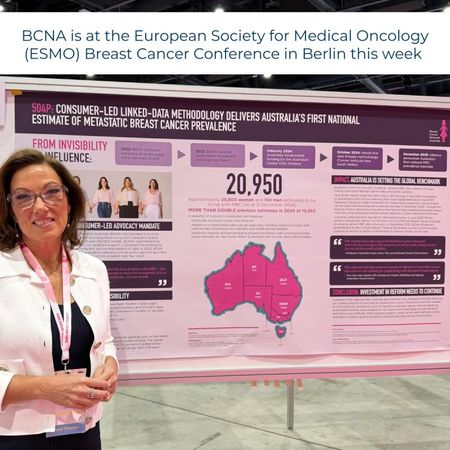
I’m incredibly proud to have represented BCNA at the European Society for Medical Oncology (ESMO) Breast Cancer Congress this year. One of the most significant moments for BCNA at the Congress was presenting Australia’s first national estimate of people living with metastatic breast cancer. For the first time, we now have a clearer understanding that around 20,950 Australians are living with metastatic disease. This is a significant milestone and one that has been a long time coming. For many years, people living with metastatic breast cancer have not been counted and have been under represented in our systems. This has made it incredibly difficult for governments, researchers and healthcare providers to fully understand the scale of need, and to plan services, support and care appropriately. It has also meant that many people in our community have not felt fully seen or recognised. That is why this work matters so deeply. By using linked health data, BCNA has helped shine a light on people with metastatic breast cancer that have too often been invisible in the data. 📊 Sharing our approach at ESMO sparked strong interest from international audiences, with many recognising the importance of not just counting diagnoses, but recognising people living with ongoing disease. It was incredibly encouraging to see Australia acknowledged as a leader in this space. More importantly, it reinforced that our advocacy here at home is helping shape global conversations about how we better understand and support people living with metastatic breast cancer 🌍 But for me, this is about much more than data. It is about people. It is about ensuring that every person living with metastatic breast cancer is acknowledged within our health system, that their experiences are understood, and that their needs are not overlooked. It is about dignity, visibility, and making sure no one feels forgotten 🤝 Being able to carry your stories and your experiences into a global forum was something I did with great pride and responsibility. Moments like this show what is possible when we come together as a community and advocate for change. The discussions at ESMO reinforced how rapidly breast cancer treatment is evolving globally, particularly in precision medicine, biomarkers and targeted therapies. But they also highlighted the growing gap between what science can offer and what patients can actually access through health systems. For Australians living with breast cancer, these conversations matter. International forums like ESMO help shape advocacy here at home- supporting efforts to improve access to new treatments, ensure equitable care regardless of postcode, and better recognise and support the growing number of people living longer with metastatic breast cancer. 👉 You can see a glimpse of my time at the conference here: https://www.instagram.com/bcnapinklady/reel/DYRW8tJiFcf/ 💊Impacts of the 2026–27 Federal Budget While I was proud to represent our community internationally, I have also been reflecting closely on the 2026 to 2027 Federal Budget and what it means for people living with breast cancer here in Australia. There are positive elements, including continued investment in precision oncology and medical research. Advances in targeted therapies, genomics and personalised medicine are changing what is possible for people with breast cancer, and Australia must continue to invest in innovation and research. But innovation only matters if people can actually access it. One of BCNA's key concerns remains timely and affordable access to medicines, particularly the Pharmaceutical Benefits Scheme. Too often, Australians face delays in accessing new and potentially life-extending treatments that are already available in comparable countries. These are not abstract delays. They are real and they impact on people's lives and the precious time they have with their families and loved ones. Without meaningful reform and sustained investment, there is a real risk that Australia will fall behind internationally and that a two-tiered system will continue to emerge - where access to treatment depends on someone’s financial capacity rather than their clinical need. That is not acceptable. Access to the best available care should never be determined by postcode, income or circumstance. This is why BCNA continues to advocate so strongly in this space, including current work to improve access to treatments like tucatinib and Zoladex 💊 We will keep advocating for a system that is fair, responsive, and centred on people. I want you to know that this work is ongoing and that your voices are at the heart of it. Every story, every shared experience, and every conversation helps us strengthen our advocacy and drive change. At home and on the global stage, this is about one thing: making sure you are seen, heard and supported. BCNA will keep showing up, speaking out, and pushing for a system that delivers the care you deserve💪52Views3likes0Comments🎉🏃♀️Celebrating Sarah’s incredible marathon milestone!
We love sharing moments of strength, joy, and achievement from within our community, and today we are celebrating some truly wonderful news from Sarah, one of our Consumer Representatives. This week, Sarah completed the London Marathon, an extraordinary achievement at any time, and even more remarkable while living with metastatic breast cancer. Covering 40 kilometres through some of London’s most iconic sights, Sarah described the day as “big” in every sense. From Big Ben to the Tower Bridge and a powerful finish down The Mall, it was a marathon filled with determination, challenge, and unforgettable moments. Like many long distance runners, Sarah experienced highs and lows along the course. She started strong, slowed to soak up the atmosphere, and faced the infamous wall later in the race. With grit and resolve, she regrouped, kept moving forward, and finished strong, supported by the cheers of the crowd and the encouragement of loved ones along the way. What makes this milestone especially meaningful is the reflection Sarah shared afterwards. For the first time, she embraced that being “awesome” is not about times or performance, but about showing up, persevering, and doing something extraordinary simply by being there. Only a small percentage of people ever complete a marathon. Fewer still complete more than one. And the number of people who have completed 13 marathons while living with metastatic breast cancer is incredibly small. That makes this achievement not just impressive, but deeply inspiring. Sarah also shared how powerful it was to see the stories of others running for loved ones, causes, and personal reasons. A reminder of how sport, movement, and community can connect us and lift us up in unexpected ways. We are so grateful to Sarah for being willing to share her experience with our community. Stories like this remind us that there is no one way to live with metastatic breast cancer, and that moments of strength, pride, and joy still matter. 💪 Congratulations Sarah! Sarah is a member of the Seat At The Table consumer representative group. For more information on this program and how BCNA is ensuring lived experience is at the core of every policy change and research project, visit: https://www.bcna.org.au/our-impact/for-consumers/seat-at-the-table-program Join BCNA's Online Network group for people living with metastatic breast cancer.329Views5likes1Comment💊 Update: Changes to Ribociclib (Kisqali) Storage & Packaging
We wanted to share an important update for anyone currently taking ribociclib (Kisqali), a targeted therapy used for HR-positive, HER2-negative breast cancer (early or advanced), often alongside hormone therapy. 🔄What’s changed? From early May, ribociclib tablets no longer need to be stored in the fridge. They can now be kept at room temperature (below 30°C). 📦During the transition period Some packs will still have the old refrigeration instructions Others will reflect the new room temperature guidance You may notice changes to packaging, including: A longer expiry date (up to 24 months) Different blister pack sizes A new layout showing how many tablets to take each day 💡Why the change? The medication itself has not changed. Updates to manufacturing and packaging now allow the tablets to be stored safely at room temperature. Because of this transition, both “old” (refrigerated) and “new” packs will be in circulation for a while. ✅What do you need to do? Always follow the storage instructions on your specific pack If your pack says to refrigerate, continue to do so until it’s finished Don’t be concerned if packaging looks different, the medicine remains the same Speak to your healthcare team if you have any questions or concerns For more information check out the following resources 👉Early breast cancer 👉Metastatic breast cancer As always, we’re here to support you. If you’ve noticed these changes or want to share your experience, please call our Helpline on 1800 500 258 Monday-Friday 9am-5pm598Views1like0Comments💬 Access to treatment matters - an update on Tucatinib
Right now, hundreds of Australian women with HER-2 positive breast cancer are stuck in limbo, denied affordable access to a life-extending drug, Tucatinib. Tucatinib has been approved for listing on the Pharmaceutical Benefits Scheme (PBS) by our own government, and is easily available for women in other countries. Despite the urgency, negotiations between Pfizer and the Australian Government have stalled, denying Australian women affordable access, and they're running out of time. It’s a trend we’re seeing more often with other drugs and health concerns: delay tactics from big pharmaceutical companies and lack of leadership from the Australian Government. All the while, it’s the patients who suffer. We won’t stop fighting for these women to live a better quality of life and have more time with their families while they still can. Vicki Durston, BCNA’s Director of Policy, Advocacy and Support Services, explains how our system is failing women with metastatic breast cancer and that we must address the growing threat to medicine access caused by big pharma stalemates. Read more about this and how it affects Australians like Georgie Cooper, 46 years old with 3 teenagers living in Melbourne who has been navigating metastatic breast cancer for eight years.108Views3likes3Comments🩷1 week until Pink Bun is back!🫓
Just one week left until our 2026 Pink Bun Campaign kicks off with Bakers Delight! 🎉 From 14 – 27 May, buy a pink Fun Bun 6 Pack from your nearest Bakers Delight, 100% of sales go to BCNA so we can continue supporting all Australians affected by breast cancer 🩷 more details coming soon.... 👀Wach this space!35Views3likes0CommentsPolicy & Advocacy Update - Vicki Durston - Apr26
Hi everyone, I hope you are doing well today. I wanted to share some reflections with our Online Network community, because many of the issues we are hearing about right now go to the heart of why this community exists. Thank you for being here, for supporting one another, and for continuing to lend your voices to the changes that are so urgently needed. This is about access, advocacy, and what happens when the system does not move fast enough for the people depending on it. Access delayed is access denied 🕰️ Australians deserve a Pharmaceutical Benefits Scheme that delivers timely, affordable access to life saving medicines. It is one of the foundations of our health system, and something Australians trust to be there when it matters most. Right now, that trust is being tested. Women living with metastatic breast cancer still cannot access tucatinib, an evidence based therapy for HER2 positive brain metastases. The Pharmaceutical Benefits Advisory Committee recommended tucatinib for PBS listing in December 2025. Despite this, negotiations between the Australian Government and Pfizer have stalled on price, leaving the medication unaffordable at $64,000-$70,000 for treatment. This is more than an administrative delay. It represents a breakdown in the system. For women with metastatic breast cancer, time is not a policy concept. Disease progresses. Treatment options narrow. Time with loved ones disappears. When neither government nor industry moves, it is women who carry the consequences. As highlighted recently in The Australian, BCNA is raising awareness about what this failure means for women with metastatic breast cancer. This is not just about one medicine. Allowing PBAC recommended therapies to stall indefinitely risks setting a dangerous precedent that could undermine timely access to future medicines across many disease areas. The reality of metastatic breast cancer 🎗️ People living with metastatic breast cancer continue to tell us that the public conversation does not reflect their reality. While pink ribbons, survivorship and positivity have their place, they do not capture what it means to live with incurable disease. As Dr Ilana Galgut has shared, many people with metastatic breast cancer feel the pressure to present a version of themselves that feels palatable to others, while carrying the ongoing reality of scans, progression and uncertainty. People are living longer, but longer does not mean easier. It means ongoing treatment, constant monitoring, fear of progression, and for some, devastation when disease spreads to the brain. This is where awareness must move beyond storytelling. When women courageously make themselves visible, the system must respond with urgency, fairness and access to treatment. It is not acceptable to ask people to share their truth while access to medicines like tucatinib collapses quietly behind closed doors. Modern treatments need modern care models 🏥 Cancer treatment has changed, but too often our models of care have not kept pace. Today, more Australians are receiving oral cancer therapies at home. For many, this reduces time in hospital and improves quality of life. But oral treatments can be dangerously underestimated. Too often, taking a tablet is treated as predictable and low risk. Yet questions remain unanswered. Who monitors adherence? Who manages toxicity? Who identifies early deterioration? Who intervenes before someone presents to emergency? We are hearing directly from nurses, nurse practitioners and oncologists who are calling for care to be reimagined. Nurse led clinics, electronic patient reported outcomes, digital monitoring, urgent symptom clinics, specialist telehealth and improved navigation pathways all exist. The challenge is not innovation. It is whether the system is willing to listen and act. With MASCC coming to Melbourne in June, one of the world’s only major conferences dedicated entirely to supportive cancer care, we urge those working in cancer care, research and policy to engage deeply with the global evidence and consider how change can be implemented locally. When advocacy works ✨ Amid these challenges, it is important to acknowledge what sustained advocacy can achieve. Australia has now passed landmark legislation banning genetic discrimination in life insurance. This reform means people can access genetic testing without fear that results will be used against them when seeking life insurance. This change did not happen quickly. It followed more than a decade of determined advocacy led by Dr Jane Tiller and Krystal Barter, supported by researchers, organisations and advocates across the country, including BCNA. It is a powerful reminder that even when progress feels slow, persistence matters. For women at risk of breast cancer, this reform removes a significant and unfair barrier. It creates greater confidence to access information that can influence prevention, early intervention and life changing decisions. Where we stand now 💬 Advocacy is not abstract. It is deeply human. It is about ensuring women living with metastatic breast cancer are not left waiting while negotiations stall. It is about designing care systems that support people receiving treatment at home. It is about removing barriers that never should have existed. BCNA is calling on our community, clinicians, researchers, leaders and decision makers to stand with us and demand urgent access to tucatinib. For women with metastatic breast cancer, delays are not theoretical. They are measured in time women do not have. Australians deserve better, and together, we will keep pushing for a system that delivers when it matters most 💙39Views4likes0Comments💊Advocacy Update: Standing Strong for Access to Tucatinib
We wanted to share an important update on BCNA’s advocacy for tucatinib, a targeted therapy used to treat HER2‑positive metastatic breast cancer. 📍 Where things currently stand While tucatinib has received a positive PBAC recommendation, talks to secure its listing on the PBS have stalled, particularly around pricing between the Australian Government and Pfizer. In the meantime, the current cost to patients is around $64,000, creating significant financial barriers and uncertainty for those who need it. 🔥 Advocacy momentum is building Momentum in BCNA’s advocacy continues to build, with strong media engagement helping to raise awareness, including an article in The Australian, coordinated activity across BCNA’s Instagram, Facebook and LinkedIn channels, and a radio interview on ABC Melbourne. Each of these moments helps keep tucatinib access firmly on the public and policy agenda. 🤝 What comes next Behind the scenes, we are actively progressing advocacy with both government and Pfizer, and a number of potential pathways are being explored to address this. We remain focused on keeping pressure on Pfizer and decision-makers while also identifying any interim options. We’ll continue to keep you informed as things progress and will reach out if there are any specific actions we’d like your support with.41Views3likes0Comments🎉A Landmark Win: Australia Bans Genetic Discrimination in Life Insurance!
Declared today - what a start to the month! After ten years of sustained advocacy, Australia has passed legislation banning genetic discrimination in life insurance. This is a historic moment for fairness, medicine, and genomic health. 🧬The bill has now passed the Senate and will become enforceable in October 2026, giving insurers time to update their systems. Once active, Australians will finally be able to access genetic testing without worrying about how their results might affect life insurance 🎉 💙 This reform follows years of work from advocates including our very own Vicki Durston, and Monash University’s Dr Jane Tiller who described the outcome as extraordinary and vital for protecting everyday Australians. It also creates new opportunities for preventive genomic screening through programs like DNA Screen, which has already provided life‑saving information to participants. 🌺 Stories like that of 22‑year‑old Mia Hodder, who carries a BRCA2 variant, show the real impact of this shift. She shared that genetic testing empowered her to take preventive action and expressed relief that others will now be protected from discrimination when making similar choices. 🎊This legislation marks a major step forward for public health, early detection, and equitable access to genetic information. A huge victory for medicine, for genomics, and for fairness. More updates will follow as the implementation date approaches, if you're interested in learning more, you can read the Monash University media release here.149Views6likes2Comments