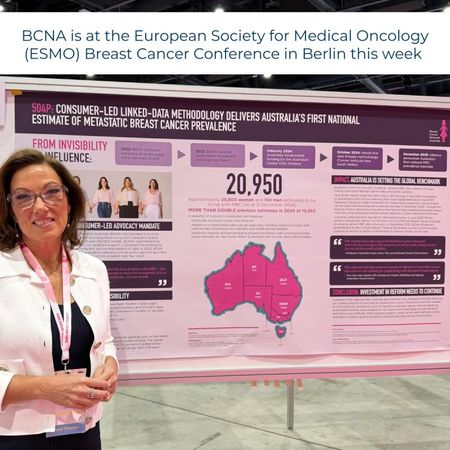
Hi everyone, I hope you are doing well today. I wanted to share some reflections with our Online Network community, because many of the issues we are hearing about right now go to the heart of why this community exists. Thank you for being here, for supporting one another, and for continuing to lend your voices to the changes that are so urgently needed. This is about access, advocacy, and what happens when the system does not move fast enough for the people depending on it.
Access delayed is access denied 🕰️
Australians deserve a Pharmaceutical Benefits Scheme that delivers timely, affordable access to life saving medicines. It is one of the foundations of our health system, and something Australians trust to be there when it matters most. Right now, that trust is being tested. Women living with metastatic breast cancer still cannot access tucatinib, an evidence based therapy for HER2 positive brain metastases. The Pharmaceutical Benefits Advisory Committee recommended tucatinib for PBS listing in December 2025. Despite this, negotiations between the Australian Government and Pfizer have stalled on price, leaving the medication unaffordable at $64,000-$70,000 for treatment. This is more than an administrative delay. It represents a breakdown in the system.
For women with metastatic breast cancer, time is not a policy concept. Disease progresses. Treatment options narrow. Time with loved ones disappears. When neither government nor industry moves, it is women who carry the consequences. As highlighted recently in The Australian, BCNA is raising awareness about what this failure means for women with metastatic breast cancer. This is not just about one medicine. Allowing PBAC recommended therapies to stall indefinitely risks setting a dangerous precedent that could undermine timely access to future medicines across many disease areas.
The reality of metastatic breast cancer 🎗️
People living with metastatic breast cancer continue to tell us that the public conversation does not reflect their reality. While pink ribbons, survivorship and positivity have their place, they do not capture what it means to live with incurable disease. As Dr Ilana Galgut has shared, many people with metastatic breast cancer feel the pressure to present a version of themselves that feels palatable to others, while carrying the ongoing reality of scans, progression and uncertainty. People are living longer, but longer does not mean easier. It means ongoing treatment, constant monitoring, fear of progression, and for some, devastation when disease spreads to the brain. This is where awareness must move beyond storytelling. When women courageously make themselves visible, the system must respond with urgency, fairness and access to treatment. It is not acceptable to ask people to share their truth while access to medicines like tucatinib collapses quietly behind closed doors.
Modern treatments need modern care models 🏥
Cancer treatment has changed, but too often our models of care have not kept pace. Today, more Australians are receiving oral cancer therapies at home. For many, this reduces time in hospital and improves quality of life. But oral treatments can be dangerously underestimated. Too often, taking a tablet is treated as predictable and low risk. Yet questions remain unanswered. Who monitors adherence? Who manages toxicity? Who identifies early deterioration? Who intervenes before someone presents to emergency?
We are hearing directly from nurses, nurse practitioners and oncologists who are calling for care to be reimagined. Nurse led clinics, electronic patient reported outcomes, digital monitoring, urgent symptom clinics, specialist telehealth and improved navigation pathways all exist. The challenge is not innovation. It is whether the system is willing to listen and act. With MASCC coming to Melbourne in June, one of the world’s only major conferences dedicated entirely to supportive cancer care, we urge those working in cancer care, research and policy to engage deeply with the global evidence and consider how change can be implemented locally.
When advocacy works ✨
Amid these challenges, it is important to acknowledge what sustained advocacy can achieve. Australia has now passed landmark legislation banning genetic discrimination in life insurance. This reform means people can access genetic testing without fear that results will be used against them when seeking life insurance. This change did not happen quickly. It followed more than a decade of determined advocacy led by Dr Jane Tiller and Krystal Barter, supported by researchers, organisations and advocates across the country, including BCNA. It is a powerful reminder that even when progress feels slow, persistence matters. For women at risk of breast cancer, this reform removes a significant and unfair barrier. It creates greater confidence to access information that can influence prevention, early intervention and life changing decisions.
Where we stand now 💬
Advocacy is not abstract. It is deeply human.
It is about ensuring women living with metastatic breast cancer are not left waiting while negotiations stall.
It is about designing care systems that support people receiving treatment at home.
It is about removing barriers that never should have existed.
BCNA is calling on our community, clinicians, researchers, leaders and decision makers to stand with us and demand urgent access to tucatinib.
For women with metastatic breast cancer, delays are not theoretical.
They are measured in time women do not have.
Australians deserve better, and together, we will keep pushing for a system that delivers when it matters most 💙
Published 5 months ago
Version 1.0
Vicki_BCNA
Community Manager
Joined July 08, 2021
News and events
Follow this blog board to get notified when there's new activity