clinical-trials
54 Topics🩺LeaN On Program: reducing the risk of lymphoedema
LeaN On - a research initiative led by Professor Bogda Koczwara and developed by Flinders University in partnership with BCNA, was developed in response to a long‑standing gap in survivorship care. Lymphoedema is a chronic condition affecting the arm or hand that can develop weeks, months or even years after breast cancer treatment, yet many people report receiving little guidance about early warning signs, risk reduction or when to seek support. LeaN On is an evidence‑based digital platform designed to support people who are living with, or concerned about, lymphoedema after breast cancer. The platform guides users through a simple 12‑step online journey, with each step offering small, manageable and practical information to help people: understand what lymphoedema is recognise early signs and symptoms take actions now to reduce risk know when and how to seek professional support The platform is currently being trialed through a research study, evaluating how lymphoedema support can be delivered online, including both self‑directed and nurse‑supported options. Its online design allows people to access guidance regardless of where they live, including in regional and rural areas where access to specialist care can be limited. Consumer perspectives have been embedded throughout the project. Participants for co‑design activities were recruited through the Review and Survey Group, and BCNA supported the research by appointing a trained Consumer Representative to the project team. This ensured lived experience informed both the development of the platform and the research approach. Both the platform and the study underpinning its development have now been published, and people affected by breast cancer are invited to trial LeaN On by contacting [email protected] Learn more about the LeaN On project: BCNA overview article Flinders University article and trial information Published study58Views1like0CommentsOmico - 'Cancer and Genomics Webinar'
I recently attended Omico's 'Cancer and Genomics Webinar' which I found insightful. The webinar is now available to watch on demand—whether you missed it, want to revisit key insights, or share it with others who may benefit: Webinar Recording What’s Covered in the Webinar: ✔️ The role of precision oncology and CGP in today’s cancer care ✔️ Partnering with your oncologist to explore CGP and targeted treatments ✔️ Understanding clinical trials—how matching works and what participation involves ✔️ A Q&A with genomics experts, clinicians, nurses, and patients82Views0likes1Comment
Garvan Institute of Medical Research - Annual Breast Cancer Public Lecture 2024
Hi all, Just watched the annual presentation from the Garvan on the state of breast cancer research in 2024 - it was very interesting and I thought others might find it useful. For those on Facebook: https://fb.watch/v6V4Y2N2_B For those not on Facebook I've uploaded a copy to YouTube: https://youtu.be/5CPHZuYuQDM George87Views3likes0Comments
A new clinical Trial in Australia - Ember-4 (Endocrine/AI alternative) - has anyone heard of it?
EMBER-4: A Randomized, Open-Label, Phase 3 Study of Adjuvant Imlunestrant vs Standard Adjuvant Endocrine Therapy in Patients who have previously Received 2 to 5 years of Adjuvant Endocrine Therapy for ER+, HER2- Early Breast Cancer with an Increased Risk of Recurrence (These links show other BC Trials that are currently 'open' in Australia - but only the WA page mentions Ember-4 ... ) https://www.breastcancertrials.org.au/research/open-clinical-trials/ https://bcrc-wa.com.au/open-clinical-trials/ https://trials.cancervic.org.au/search/ (Put Breast Cancer in the search area) https://www.australianclinicaltrials.gov.au/anzctr-search-results?search_text=breast%2Bcancer&condition_category=all&condition_code=all&recruitment_status=Recruitingðics_approval=Yes Not sure if this will help anyone - it is a different form of AI they are 'testing' ... I found this info on the Ember-4 trial on one of the Facebook BC sites ..... (BTW, this is NOT written by me and does not relate to me in any way .. ) (SERDs are an important endocrine therapy used to treat ER-positive breast cancer. Parenteral SERD Fulvestrant has been approved and used in the treatment of metastatic ER-positive breast cancer for the last 2 decades.) From a Facebook BC Post: Is anyone else on the Ember-4 trial? I found out yesterday that I was selected in the trial to get Ilumestrant (a new SERD that replaces your AI) so that is quite exciting, but I ended up with horrible diarrhoea yesterday after taking my first dose, so hopefully that is not a side-effect that continues… Ilumestrant is a Selective Estrogen Receptor Degrader (SERD) that you take instead of taking an oestrogen blocker or aromatase inhibitor… it degrades the estrogen receptor sites in the cancer cells rather than blocking your oestrogen, so it allows your body to have some oestrogen and hopefully less joint aches and pains etc… An interesting thing about it is that you must fast for one hour before you take it, and for two hours after you take it. This will not be an issue for me, but I imagine it could be hard in some situations.108Views1like1CommentBreast Cancer & Fertility - a Q&A Webinar - 20th Feb, 5 - 6.30pm
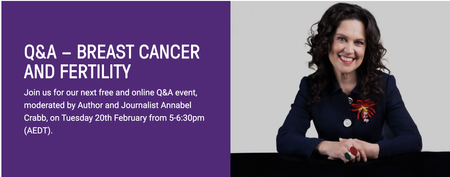
For those interested in Breast Cancer & Fertility - register for this webinar on Feb 20th. Around 4,000 women in Australia under the age of 45 are diagnosed with breast cancer each year. For those in their childbearing years decisions about treatment need to consider fertility, as treatments such as chemotherapy and hormone therapy may induce premature menopause and can reduce a woman’s chance of having children. Moderated by author and journalist Annabel Crabb, the panel of experts will discuss fertility preservation options, informed decision making, and the latest research – including the POEMS clinical trial, which your support has made possible. https://www.breastcancertrials.org.au/news/qa-events/qa-breast-cancer-and-fertility/73Views0likes0Comments
Three dimensional tissue engineering with biodegradable breast scaffolds post mastectomy
Hello all, The above is being researched by Queensland University Hospital with Prof Dietmar Hutmacher as the head. It will be a great alternative to breast implants as it replaced by regenerating tissue rather than replacing it. I am wondering if anyone is in the know about upcoming clinical trials? I noticed it in a couple of stories in daily newspaper and media, six years ago when I had my mastectomy and sentinal lobe clearance. I was hopeful when I saw it and held off having any of the current recon. surgeries. All the best and it's onwards and upwards, Maria117Views0likes1CommentQ&A – TRIPLE NEGATIVE BREAST CANCER on Tuesday 24th October from 4:30-6pm (AEDT).
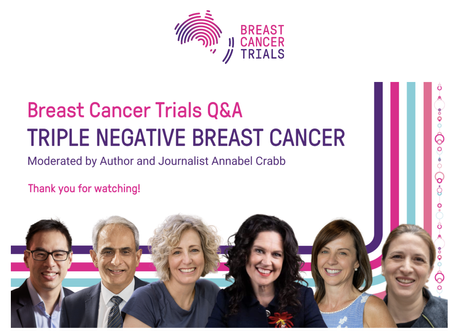
Register for the Q&A on Triple Negative Breast Cancer (Submit a question.) https://www.breastcancertrials.org.au/news/qa-events/qa-triple-negative-breast-cancer/ Triple negative breast cancer accounts for approximately 15% of all breast cancers. As the name suggests, triple negative breast cancer does not have any of the three receptors that are commonly found on breast cancer cells – oestrogen, progesterone and HER2 receptors. Anyone can be diagnosed with triple negative breast cancer but it occurs more often in younger patients who are pre-menopausal or under 50 years of age. People with a BRCA1 gene mutation also have a higher risk of this type of breast cancer. Triple negative breast cancer is a more aggressive type of tumour, with a faster growth rate, a higher risk of spreading to other parts of the body (metastasis) and of recurrence either in the breast or elsewhere. Because it does not have any of the more common receptors that can be targeted by medications, such as hormone and HER2-blocking drugs, it has fewer treatment options available. Standard treatment of early stage triple negative breast cancer typically includes chemotherapy, surgery and in many cases a course of radiotherapy. Often chemotherapy treatment is given prior to breast surgery (neoadjuvant chemotherapy), as it can effectively reduce the size of the breast cancer while providing useful information about the effectiveness of the treatment being given. Breast Cancer Trials has been researching new and better treatments for triple negative breast cancer. The CHARIOT clinical trial examined the addition of dual immunotherapy to standard chemotherapy and showed promising results in patients with treatment resistant, early-stage triple negative breast cancer. The Neo-N clinical trial is investigating whether using an immunotherapy drug together with chemotherapy, is safe and effective in treating breast cancer before surgery. Results of this study are expected later this year. Join our panel of experts as we explore triple negative breast cancer. We’ll hear firsthand from women who have a history of this type of cancer, and from world-leading researchers on the latest in research and clinical trials to improve treatments and patient outcomes207Views2likes2CommentsTriple Negative Vaccine hopes to eliminate the disease - we need these trials in Australia NOW!
This is in the UK newspaper today - hopefully these trials will be in Australia SOON .... Maybe Ask your Onc about this ..... the sooner it starts here, the better. Triple Negative Breast cancer vaccine 'could eliminate disease by 2030' : 15 women who survived aggressive tumours are still in remission up to five years later after receiving experimental shot — now doctors believe a cure is in sight https://www.dailymail.co.uk/health/article-12140391/Breast-cancer-vaccine-eliminate-form-disease-seven-YEARS.html and another report from Dec 2022 https://www.dailymail.co.uk/health/article-11400715/Three-cancer-patients-cured-experimental-vaccine-100x-cheaper-rival-shots.html102Views1like4CommentsDr Liz O'Riordan talks about her surgeries & aftermath - A UK Breast Surgeon with Breast Cancer
Dr Liz O'Riordan was diagnosed with breast cancer some years after qualifying as a breast cancer surgeon & realised that whilst she knew some of the physical effects of Breast Cancer surgery - she really was not prepared for the psychological (and indeed actual physical limitations) that she experienced, once she'd had her own surgery, chemo, rads etc - she also suffered from extreme cording that restricted her arm movement. Eventually, after a recurrence and more surgery, it prevented her from continuing as a Breast Surgeon. This is a more recent write up : https://www.nzherald.co.nz/lifestyle/dr-liz-oriordan-im-a-breast-cancer-surgeon-this-is-what-surviving-cancer-myself-taught-me/GWGO5EWTRNFAHB7MLHU5SGPTIM/ In her own 'blog' - she writes candidly - from her own diagnosis, surgery, chemo, tabs & treatment overall with all the same fears and side effects that many of us have experienced .... Read her personal story here (then click on her 'blog': http://liz.oriordan.co.uk/ You can follow her on Instagram too https://www.instagram.com/oriordanliz - work your way thru her videos ..... they are authentic & helpful She has announced a New trial in the UK, attempting to identify younger women with higher risk of breast cancer BEFORE diagnosis - particularly those with dense breast tissue .... leading to earlier intensive testing before the 'normal age' of 40 https://www.instagram.com ; /p/Ct_-RRUINgJ/. (copy & join these 2 parts of the link, to see it as it won't load here.) Nina Lopez (who Liz interviews in one of the videos - add 'this link' after the '.instagram.com bit ... p/Ct2ESwoIkwn/) who talks about HER triple Negative BC here: https://www.the-c-list.com/stories/nina-lopez-39-shares-her-story-of-motherhood-treatment-and-resilience-as-she-lives-with-secondary-breast-cancer And below, are some of the subjects that she covers on Instagram ..560Views1like7Comments