Top Content
Forums in this Category
Category Content
Recent Content
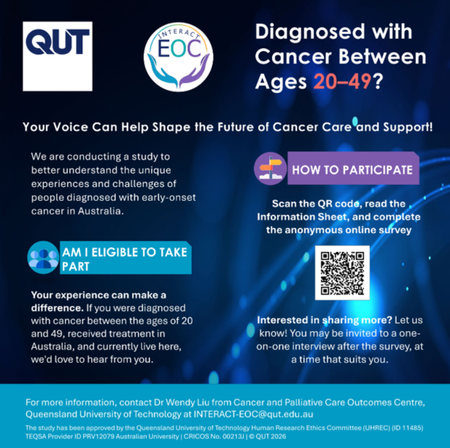
🔬 Share Your Views: Early-Onset Cancer Research 💗
Have you been diagnosed with cancer between the ages of 20 and 49? Your experience could help shape future support, services, and research for others affected by cancer. 🌟 Researchers at Queensland University of Technology (QUT) are seeking people with lived experience of early-onset cancer to share their insights through a research study exploring life during and after a cancer diagnosis. A cancer diagnosis at a younger age can affect many aspects of life, including: 💼 Work and career 📚 Study and education 👨👩👧👦 Family responsibilities ❤️ Relationships 💰 Finances and future planning The research aims to better understand the unique challenges and support needs of people diagnosed with cancer between the ages of 20 and 49, helping to inform future programs and services across Australia. This study has been approved by the QUT Human Research Ethics Committee (Project ID 11485). ✅ You may be eligible if you: • Were diagnosed with cancer between the ages of 20 and 49 • Received your diagnosis and treatment in Australia • Currently live in Australia 📝 What's involved? • An anonymous online survey (approximately 20 minutes) • An optional one-on-one interview to discuss your experiences in more detail 💡 Every story shared helps build a better understanding of what it means to live with and beyond cancer at a younger age. 📄 Interested in learning more? View the QUT flyer below.🔔 Update on access to Zoladex treatment
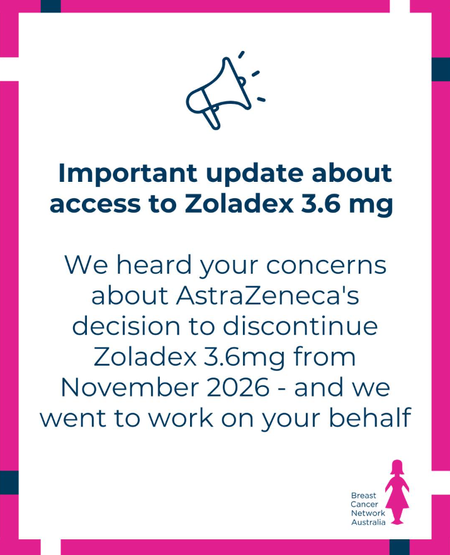
We heard your concerns about AstraZeneca's decision to discontinue Zoladex 3.6mg from 1 November 2026 - and we went to work on your behalf. After coordinating advocacy with clinicians, consumers and key stakeholders, we're pleased to share that options will be available for those affected, including a free access program for eligible patients and work underway on alternative treatment pathways. Supply continues in the meantime and we'll keep you informed every step of the way. Full details available through the link in our bio. If you need support, our Helpline is here for you on 👉 Reach out to the BCNA Helpline 1800 500 258 for information and support Read more here: 🔗 https://www.bcna.org.au/latest-news/bcna-news/update-on-access-to-zoladex-treatment337Views6likes9Comments📢 Loneliness & Social Isolation Research Study for People Living with Long-Term Health Conditions
Researchers from Monash University are looking for people with lived experience of loneliness or social isolation to take part in an important study. The research aims to better understand what makes support programs most useful, accessible and appealing for people living with long-term health conditions, including breast cancer. You may be eligible if you: ✅ Are aged 18 years or older ✅ Have experienced loneliness or social isolation (currently or in the past) ✅ Have been living with a diagnosed health condition for 12 months or longer. Examples include breast cancer, other cancers, heart disease, diabetes, anxiety, depression, arthritis, asthma and other long-term health conditions. 📝 What's involved? A confidential online survey taking approximately 25 minutes to complete. Participants can also choose to enter a prize draw to win one of ten $50 e-gift cards. Your feedback will help researchers design better support and social connection programs for people living with long-term health conditions. 🔗 Take the survey For research questions, contact: Sharon Clifford Monash University 📞 (03) 9902 4474 📧 [email protected] Thank you for considering this opportunity to share your experience and help shape future support services. 💗📣 Have Your Say on the Future of Hospital Care in Australia
You are invited to contribute to an important national consultation on the next edition of the National Safety and Quality Health Service (NSQHS) Standards. These Standards help guide the safety and quality of care provided in public, private and day hospitals across Australia. They are reviewed every 10 years, and this is your opportunity to help ensure the next edition reflects what matters most to patients, families, carers and consumers. 💬 Why participate? Your experiences and insights can help shape future hospital care, ensuring the voices of people affected by breast cancer are heard. Whether your healthcare experiences have been positive, challenging, or somewhere in between, your feedback is valuable. 📝 About the survey Takes approximately 20 minutes to complete All questions are optional You can skip questions, take breaks, and return later using the same device You may review the draft Standards or a shorter Patient and Consumer Requirements summary before participating Survey closes 25 September 2026 Please note that some questions may ask you to reflect on personal healthcare experiences and may feel sensitive. If at any time you need support, you can contact Lifeline on 13 11 14. 🔗 Complete the survey 📢 Feel free to share this opportunity with others in your networks who may be interested in providing feedback. Your lived experience is powerful. By having your say, you're helping shape safer, higher-quality healthcare for current and future patients across Australia. Thank you for helping ensure the voices of people affected by breast cancer are part of this important conversation. 💕⏱️Last chance: BCNA's Policy & Advocacy survey closes at midnight❗
Complete the survey before it closes at midnight today: https://researchsurveys.deakin.edu.au/jfe/form/SV_5p9gsRqbkfZf5zw We've already received a huge range of voices helping to shape our future Policy & Advocacy efforts - and we would love to hear from you too! Your insights will help identify what's working well, where gaps exist, and what issues need greater attention over the next four years. 📝 The survey takes approximately 15-20 minutes to complete and closes at midnight tonight. Participation is voluntary, and you can skip any questions or exit the survey at any time. Thank you to everyone who contributes to this important work and helps ensure the voices of those supporting people affected by breast cancer are heard. 💕🧠 Research Opportunity: Have You Experienced "Brain Fog" After Cancer Treatment?
Many people affected by cancer notice changes to their memory, concentration, thinking or mental clarity during or after treatment. Researchers at Griffith University are looking to better understand these experiences and how support can be improved for older Australians affected by cancer. 💗 Your experiences could help shape future support, information and services for people affected by cancer. 👥 Who can take part? You may be eligible if you are: A person who: ✅ Is aged 60 years or older ✅ Has a current or previous cancer diagnosis ✅ Has noticed changes to memory, concentration or thinking OR A caregiver, family member or support person who: ✅ Supports someone aged 60 years or older with a current or previous cancer diagnosis ✅ Has noticed changes to their loved one's memory, concentration or thinking You must also: ✅ Live in Australia ✅ Be able to complete the survey in English 📝 What's involved? Participants are invited to complete a short online survey, which takes approximately 15 to 20 minutes. The survey explores: 🔹 Experiences of cancer treatment 🔹 Changes to memory and thinking 🔹 The impact on everyday life 🔹 What support would be most helpful At the end of the survey, you can also choose to take part in a one-hour follow-up interview. 🎁 Participants will receive a gift card as a thank you for their time. Interview participants will receive an additional gift card. 🔬 About the research This Griffith University study is investigating cancer-related cognitive impairment, sometimes referred to as "brain fog", including changes to memory, concentration and thinking that can occur during or after cancer treatment. The research has been approved by the Griffith University Human Research Ethics Committee (GU Ref No: 2025/816). ❓Questions? Research Team Associate Professor Kerryn Pike 📧 [email protected]📢 Share Your Experience: Emotional Wellbeing After Breast Cancer Treatment
Researchers from Federation University Australia are seeking Australian women who have completed active breast cancer treatment to take part in a short anonymous survey exploring: 💗 Self-compassion (being kind to yourself) 💗 Fear of cancer recurrence 💗 Emotional wellbeing after treatment By sharing your experiences, you'll help researchers better understand the emotional and psychological impacts of breast cancer and contribute to improving future support for those affected. You may be eligible if you: ✅ Are an Australian woman aged 18 or older ✅ Have completed active breast cancer treatment (surgery, chemotherapy and/or radiation therapy) ✅ Can complete a survey in English Please note: ongoing hormone therapy or medication after active treatment does not exclude you from participating. 📝 What's involved? • Anonymous online survey • Takes approximately 10-15 minutes • No identifying information is collected Complete the survey here Whether you finished treatment recently or many years ago, your experiences are valuable. Study Title: Self-compassion, Fear of Cancer Recurrence and Emotional Wellbeing in Breast Cancer After Active Treatment For more information, contact: Dr Bianca Denny 📧 [email protected] 📞 0411 221 847 Thank you for considering this opportunity to help shape future breast cancer support and care. 💗📢 Research Opportunity: Share Your Views on Online Exercise Programs for People Affected by Cancer
Researchers from the University of Melbourne are inviting people living with cancer actively or post-treatment to take part in a study exploring how remotely delivered, group-based exercise programs can be made more engaging, supportive and accessible. 🤸♀️Exercise can play an important role in cancer care, helping to improve physical fitness, reduce treatment-related side effects such as fatigue, and support emotional wellbeing. While telehealth exercise programs can make it easier to access professional support, researchers are keen to better understand what helps people feel connected, motivated and supported when participating online. Who can take part? You may be eligible if you: ✅ Are aged 18 years or older ✅ Have been diagnosed with cancer at any time ✅ Are able to complete a survey online (or by telephone with research assistant support if needed) The survey is available in English, Mandarin and Vietnamese, with telephone support available in these languages. What's involved? Participants will be asked to complete a survey (approximately 25 minutes) that explores: Views on online group exercise programs Factors that would encourage participation Strategies that could improve support, engagement and personalisation Experiences with telehealth Information about cancer diagnosis, treatment and demographics Some questions may be personal, and you are welcome to skip any questions you do not wish to answer. How will your feedback help? The findings will help exercise professionals and health services design future telehealth exercise programs that better meet the needs of people affected by cancer. 🔗Participate in the survey here This study has been approved by the University of Melbourne Human Research Ethics Committee (Reference No. 2026-36117-82542-4). As always, participation is entirely voluntary. If this research is of interest to you, we'd love for you to consider sharing your experience and perspective. 💕 Thank you for helping to improve support and care for people affected by cancer.📢Have You Taken Endocrine Therapy After Breast Cancer Surgery? We'd Love to Hear From You
Have you been diagnosed with Stage 2 to 3 HER2-negative, HR-positive breast cancer and received treatment after surgery? BCNA is partnering with Inherited Cancers Australia (ICA), So Brave, healthcare professionals, and independent healthcare research agency Elbow Insight and Strategy to better understand the experiences of people diagnosed with this type of breast cancer. The findings will help improve understanding of the challenges, needs, and experiences of people affected by breast cancer, and help inform future support for our community. 🌸 Who can participate? 👇 You may be eligible if you: ✅ Are aged 18 years or older ✅ Have been diagnosed with Stage 2 to 3 HER2-negative, HR-positive breast cancer ✅ Are currently taking, or have previously taken, treatment after breast cancer surgery, including hormone-blocking (endocrine) therapy What's involved? 📝 The study starts with a few short screening questions to confirm eligibility. If eligible, you'll be invited to: ✨ Complete a 25-minute online survey ✨ Optionally register your interest in a second phase involving a 7-day online diary (approximately 45 minutes in total) As a thank you for their time, participants will receive a payment for participating. 💕 👉 Interested in participating? Register for the Research Study Here Thank you for helping us better understand and support people affected by breast cancer. 💖🗣️ Invitation to share your voice: Understanding Cancer Related Stigma Through Lived Experience
BCNA’s Consumer Engagement team is inviting members of our Online Network to share their experiences of stigma and shame following a cancer diagnosis. Cancer related stigma is not only about visible changes. It can be social, cultural, emotional, and systemic. It can affect how people see themselves, how others respond to them, and how safe they feel seeking care or support. These experiences are often deeply personal, and they can vary widely across communities, cultures, and healthcare settings. 🌏 Why your perspective matters In June, a BCNA trained Consumer Representative will be presenting at the Multinational Association of Supportive Cancer Care Australia Conference. This presentation will bring consumer voices into an international conversation about whole person care, supportive care, and the importance of patient partnership in addressing stigma. To ensure this presentation truly reflects the diversity of experiences across Australia, we are gathering insights from our broader network of members. 📝 Take part in the survey By completing this short survey, you will help shape the content of the presentation and strengthen the messages shared with clinicians, program leaders, policy makers, and researchers. Your voice will help ensure lived experience remains central to conversations about stigma, care, and support. 👉 Take the survey here 🗓️ The survey closes on Friday 8 May 2026 📩 If you have any questions, please contact [email protected] Thank you for considering sharing your experience and helping amplify the voices of people affected by cancer.