
Forum Widgets
Recent Discussions
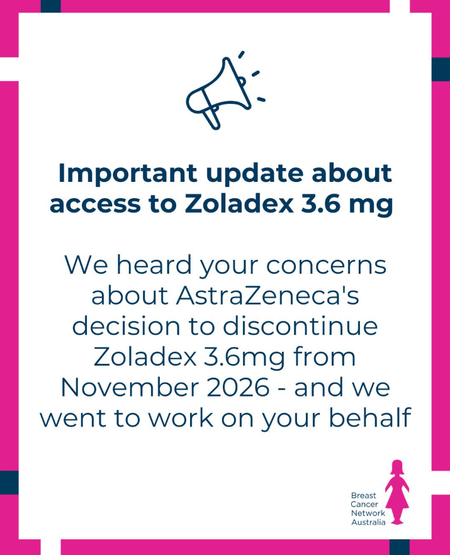
🔔 Update on access to Zoladex treatment
We heard your concerns about AstraZeneca's decision to discontinue Zoladex 3.6mg from 1 November 2026 - and we went to work on your behalf. After coordinating advocacy with clinicians, consumers and key stakeholders, we're pleased to share that options will be available for those affected, including a free access program for eligible patients and work underway on alternative treatment pathways. Supply continues in the meantime and we'll keep you informed every step of the way. Full details available through the link in our bio. If you need support, our Helpline is here for you on 👉 Reach out to the BCNA Helpline 1800 500 258 for information and support Read more here: 🔗 https://www.bcna.org.au/latest-news/bcna-news/update-on-access-to-zoladex-treatment 341ViewsSign in to react to this post
 9Comments
Aligning PBS Policy with Contemporary HER2-Positive Metastatic Breast Cancer Care
I am concerned about a structural problem in how HER2-positive metastatic breast cancer is managed under current PBS rules. Patients who achieve an excellent response to T-DM1 or T-DXd cannot step down to maintenance trastuzumab without being deemed to have “failed” the antibody–drug conjugate. In practice, stopping treatment is administratively treated as progression. This creates several problems: It discourages rational de-escalation after deep response. It forces patients to remain on intensive agents despite cumulative toxicity. It prevents planned treatment breaks or step-down strategies. It risks exhausting future options prematurely. In many other jurisdictions, sequencing is more flexible. De-escalation to maintenance trastuzumab, with or without endocrine therapy, after a strong response is not automatically classified as drug failure. Re-challenge with an ADC remains possible if progression later occurs. The current PBS structure appears misaligned with contemporary oncology, where depth of response, toxicity management, local treatment of oligoprogression, and strategic preservation of future options are central principles. From a health economics perspective, allowing maintenance trastuzumab after response to T-DM1 or T-DXd is likely to be cost-neutral or cost-saving. It may reduce cumulative ADC exposure, delay subsequent high-cost therapies, and lower toxicity-related healthcare utilisation. In my own case, multiple HER2-targeted regimens have achieved systemic control. My disease has presented as isolated liver oligoprogression, managed with histotripsy overseas at significant personal expense. The resistant lesions were destroyed locally. I now have minimal detectable disease, yet very limited PBS-funded systemic options remaining because of line restrictions. This is not solely a personal issue. As ablative and other local treatments expand, more patients will experience prolonged control with episodic oligoprogression. Funding rules need to reflect this evolving reality. Without reform, Australian patients risk running out of PBS-listed options earlier than necessary, remaining on unnecessarily toxic regimens, and falling behind international standards of adaptive HER2 management. The intent of PBS safeguards is understandable. However, equating treatment cessation with treatment failure is often biologically and clinically inaccurate. Greater flexibility around maintenance trastuzumab and ADC re-challenge should be considered if Australia is to keep pace with modern HER2-positive metastatic care.72ViewsSign in to react to this post1Comment📢 Capivasertib (Truqap) to be listed on the PBS!
The Australian Government has announced that as of 1 October capivasertib (Truqap) will be listed on the Pharmacetucial Benefits Scheme (PBS), providing another vital option for Australians with HR+/HER2- metastatic breast cancer. This means more equitable access to a treatment that previously cost over $98,000. This decision addresses an urgent need for effective treatments and provides another vital option for patients when their cancer has developed resistance to existing therapies. BCNA remains committed to fighting for equitable access to innovative treatments and supporting those living with metastatic breast cancer through every step of their journey. Read more about the announcement at https://www.bcna.org.au/latest-news/bcna-news/government-announce-access-to-capivasertib-truqap-another-option-for-those-living-with-metastatic-breast-cancer/53ViewsSign in to react to this post0Comments
You’ve seen all recent content
Tags
- medication1 Topic
- metastatic breast cancer1 Topic
- PBS1 Topic
- treatment1 Topic
- zoladex1 Topic
- advocacy1 Topic
- news1 Topic