
User Profile

Wildplaces
Member
Joined 8 years ago
User Widgets
Contributions
Re: Two steps forward, one step back – news on access to CDKs in second line treatment
ESMO 2018 Commenting on the findings for ESMO, Dr Carmen Criscitiello, European Institute of Oncology Milan, Italy, said: “These data were much awaited, as the clinical benefit obtained with CDK 4/6 inhibitors was incontestable, but there was the hot question whether the PFS benefit translates into OS benefit. This randomised Phase III trial shows for the first time an improvement in OS with a CDK4/6 inhibitor in the metastatic setting for ER+/HER2- breast cancer.” https://www.esmo.org/Press-Office/Press-Releases/PALOMA3-breast-cancer-palbociclib-fulvestrant-Cristofanilli The data is slowly coming in to show what most of us expected clinically - overall improved survival with CDK4/6, numbers stronger in bone only disease.Re: Kisqali on PBS, very few will get it.
One final word - absolutely if you have questions regarding you INDIVIDUAL eligibility and access to these drugs you must speak to your oncologist - there are both PBS, compassionate grounds and trials available in Australia and they will chosen based on your individual case history. My comments where regaining ongoing advocacy for these drugs and other options being available for all women who may need them - they were NOT specific to any one individual. The OP commented on some of these not being available to all women - and we went looking for clarification of what is on PBS. In no way did any comments refer to specific individuals and their management.Re: Kisqali on PBS, very few will get it.
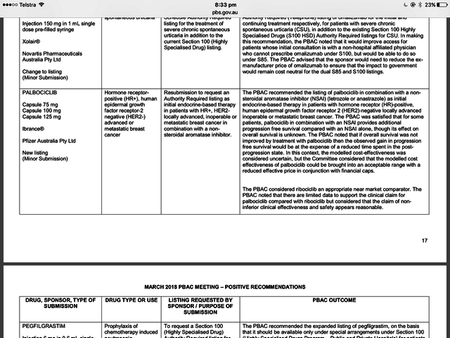
WendyLou, This is the email of received and in fairness to BCNA - I think it makes sense. I read the PBS listing like you did - I explained why. Dear... I wanted to reach out to you to respond to one of the posts you responded to around eligibility criteria for PBS ribociclib. I followed up today with Novartis seeking clarification as to whether there was a restriction for women who had received and aromatase inhibitor in the adjuvant setting. The lead medical advisor advised me today that there is no restriction on women who progress to develop metastatic disease following a diagnosis from early breast cancer even if they did receive an AI in the past for their early stage disease. Obviously this needs to be a one on one discussion between a doctor and individual women as to what the best treatment is and past treatment will come into those discussions. I am concerned that your post about concerns for all those women who have received an AI in the post not being able to access this drug should they go onto progress to metastatic disease sends a false message and is causing angst amongst the online community. Is it possible that you could repost to advise the online community that BCNA has been able to clarify this for you and reassure women who are worried? Happy to chat to you over the phone if you need further clarification. Kind regards Danielle I corrected my post. This is the PBAC recommendation It adresses Palbociclib and finds Ribociclib a comparable alternative in the last paragraph. I knew that the govermenrt did not reach a deal with Pfizer on Palbociclib. IMO the PBS phraseology is skewed. I was not aware that men have been included and are happy to hear it - I think we are still missing some big groups from the listing - so yes progress, but a lot of work left to do. That is really all I have to say.Re: Kisqali on PBS, very few will get it.
Wendy Lou, That was my first read of the PBS criteria - posted above . i have been contacted by BCNA and been told they had consulted a Novartis Medical Advisory - and that is not correct women treated with AI in early disease adjuvant setting are eligible.i have since reposted in bold letters as to not cause undue angst. i remain sad as who is covered and how the ministry made their decision. From Lisa post Mid June and what I have read from PBAC, men were not covered as the evidence was weaker - it will always be weaker it is harder to get the same numbers for studies. Now according to Giovanna it seems that between mid June and 1st of July - outside PBAC ( because I don't think there was a special meeting reported) men are now covered. If that is correct that would be great. it still leaves three central questions: 1. What about women with HR positive Metastatic disease who have been on AI but where the oncologist feel they would benefit from a CDK? 2. What about the combination of Faslodex and CDK as a second line - study numbers there are very good? 3. Why was Ribociclib chosen over Palbociclib - similar side effects esceot for the potential cardiac complications with Ribociclib, and what about Abemaciclib which has been shown to work as monotherapy in heavily pretreated women with Metastic breast cancer. We don't talk about this enough - and it is difficult for both patients first and foremost but also clinicians - who are forced to make decisions whether to discuss ALL available options knowing that some will be out of affordability - in this group of patients facing chemo and death. I think its important to value the effort BCNA continually puts in supporting women with BC - that is their mission - but I would like to see more open conversation about how tough it is to get these treatments in Australia. Be happy about successes but know and admit women have a hell of a fight on their hands to get latest treatments and they are costly on those many grounds. Be respectful of the unthinkably tough process they go through. On a note of hope trials on CDK 7 and CDK 12 are taking place - albeit phase 1.Re: Kisqali on PBS, very few will get it.
Hi @Danielle_BCNA , Lisa_BCNA said: Hi @traveltex, unfortunately the PBS listing for ribociclib is for women only because there is not enough evidence that ribociclib is an effective treatment for men. The first line trials for ribociclib only recruited women. However, trials in later lines did include men. As the evidence emerges around benefit for men with breast cancer we will keep everyone updated. We will also continue to advocate for new drugs to treat breast cancer to be available on the PBS. The best advice is to talk to your medical oncologist about options for accessing the drug through compassionate access schemes or clinical trials. I knew I had that part of the info from BCNA - can you please correct and tell us - has Novartis confirmed it is available for men on PBS? I have a good friend with BC who would be very interested.Re: Kisqali on PBS, very few will get it.
@Danielle_BCNA - it would be great if men with Metastatic BC could access it - the PBAC recommendation was for women - do you have confirmation from Novartis that men can access Ribociclib under PBS should it be appropriate as management? If so are there any restrictions around it?Re: Kisqali on PBS, very few will get it.
According to BCNA and a Novartis advisor - my understanding is that - YES you are, if it is appropriate treament for you and you are prescribed that drug as a first line - ie immediately after diagnosis no other treatment. BCNA - please correct if that is not correct. The problem is that is you have been diagnosed with Mets and have been on a AI - you would not be able to access it on PBS. So women with mets on AIs who have waited for it to arrive to PBS and have not prev accessed it through a study or compassionate - can not access it on PBS. If you are a man you can not access it on PBS. If your doctor wants you to have it with Faslodex and not an AI - I think again you can not access it on PBS. i hope I have that right - BCNA - please let us know if I am incorrect - I am happy to be told the circle is wider than that.Re: Kisqali on PBS, very few will get it.
I have been contacted by BCNA - thank you for clarifying and following this up - I stand corrected. According to Novartis - (so yes Arpie it is indeed strange that on the " initial treatment - one of the conditions states " patient must not have been treated with AIs" but then for Continuing or Grandfather patients the phrase " patients must have not been treated with AIS for this condition" is used) still I am happy to write. Ribociclib is available on PBS for women with early disease who use AIs in the adjuvant setting and go on to progress to advanced disease provided they fulfill the time criteria of accessing the drug. Arpie posted the PBS criteria for all to look at. Thank you!! So the restriction to my understanding involves women who have Metastatic Breast Cancer and have been on AIs. And again my understanding is that men with Metastatic Breast Cancer can not access it on PBS. BCNA please weigh on this. My statement about the time lag between FDA approval in the States PBS authority is correct - it took us three years to bring the drugs to PBS. My understanding is Palbociclib is not available because a satisfactory financial deal could not be reach between the ministry and Pfizer. Ribociclib does have potential cardiac side effects, albeit rare - not reported with Palbociclib - women who take Ribociclib have regular cardiac monitoring. Finally BCNA - Is Ribociclib available with Faslodex on PBS? Its time to fight hard for solid options for Metastatic Breast Cancer. Time for Beyond Pink!Re: Kisqali on PBS, very few will get it.
1 in 8 women in Australia gets breast cancer. Of those diagnosed with breast cancer 20-30% will have a recurrence during their life span. For those living with Metastatic Breast Cancer there is no cure. Metastatic Breast Cancer women will die of their disease. Two thirds of these women will die of their disease within 5 years. CDK 4/6 drugs offer women with HR breast cancer the opportunity to at the very least delay the onset of chemotherapy drugs. Palbociclib is the most known and certainly the drug on which we have the most data. It was approved by the FDA in February 2015 by accelerated approval. Canada and the European Union followed suite. More than 3 years later this drug still NOT available in Australia on PBS. Ribociclib has potential cardiac side effects that have not been the reported with Palbociclib. The choice over which drug came down to money - the cheaper of the CDK4/6 has been granted PBS approval. Furthermore it is limited to women who have not been on AI - so what about all the postmenopausal women on AIs who develop metastasis? BC peak incidence is mid 50s through 60s. It is also not on PBS for men who have Metastatic breast cancer. And yes, while they are compassionate programs - these women are going through enough not to be put through one more loop, one more jump, one more reminder of how vulnerable they are. I agree that BCNA has not been entirely open about the ongoing fight and the political scene behind trying to bring CDK inhibitors to Australian women who are dying from Mestatstic Breast Cancer.
Groups
No places to display